
A scope of work is a list of promises in a fixed order
A scope of work lists what a crew will do, where, with what equipment and in what order. It is the document you sign, the one an adjuster may read and the one you compare against the finished job.
For a homeowner in Uniondale, NY it can look like a wall of abbreviations. Once you know the sections and the units, a scope becomes readable, and gaps stand out. This guide is about reading and comparing scopes. It is separate from the question of what a good estimate should contain.
The usual sections, in order
Contractors format scopes differently, but most follow the order the work happens in. Reading in that order helps you spot missing steps.
- Site and loss details: address, date of loss, source of water, and the water category if stated.
- Emergency services: stopping or isolating the source, protecting contents, and extracting standing water.
- Moisture mapping: meter and thermal camera readings that show where the water went.
- Demolition: materials removed because they cannot be dried in place.
- Drying: equipment placed, days running and monitoring visits.
- Cleaning and treatment: surface cleaning, antimicrobial application and air scrubbers where used.
- Disposal: hauling debris away.
- Rebuild: replacing what was removed, often listed as a separate phase.
If a scope jumps from extraction straight to rebuild, ask where the drying section went.
Glossary: units and terms you will see
The units tell you how a line is measured, and measurement is how two scopes can be compared fairly. This glossary covers terms commonly seen in scopes.
| Term or unit | What it means | What to check |
|---|---|---|
| SF (square feet) | Area of a surface, such as floor, wall or ceiling. | Is the area measured per room and does it match the room you see? |
| LF (linear feet) | Length, used for baseboard, trim and flood cuts along a wall. | Is the cut height or trim run stated? |
| EA (each) | A count of items such as an air mover or a fixture. | How many, and for how many days? |
| Day or per-day | A drying line billed or counted by days of equipment running. | Is the day count tied to readings, not just a guess? |
| Flood cut | Drywall removed to a set height above the floor. | Is the height written down? |
| Pad | The cushion layer beneath carpet. | Is it removed, replaced or both? |
| Antimicrobial | A treatment applied to surfaces after cleaning. | Which areas, and why? |
| Containment | Plastic barriers that limit dust and spread. | Where is it placed and removed? |
| HEPA air scrubber | A filtering unit that cleans the air during and after demolition. | Is a day count listed? |
Ask for any abbreviation you do not recognize to be spelled out in writing.
Drying equipment lines
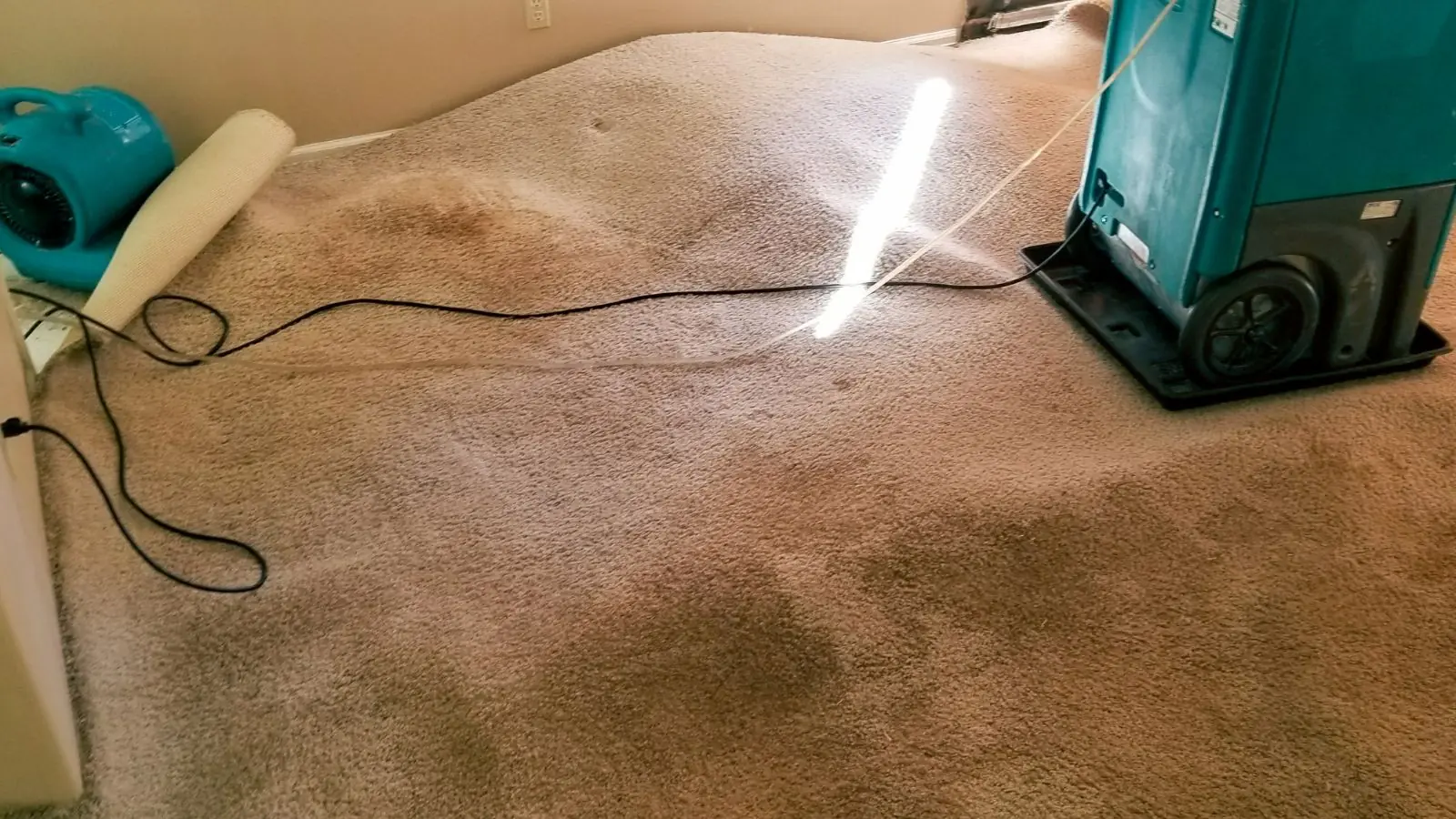
The drying section should say what runs, where and for how long. Look for air movers, LGR or desiccant dehumidifiers, and sometimes drying mats for floors. Each should have a count and a day figure, and the scope should say when readings will be taken. The method behind these lines is described in structural drying and dehumidification.
A scope that names the equipment but not the number of units or days is incomplete. A scope that lists the units but never mentions moisture readings leaves you with no way to know when the job is done.
Demolition, disposal and the rebuild phase
Demolition lines should use measurements, like square feet of drywall or linear feet of baseboard. Disposal is often a separate line, so check that hauling debris is accounted for somewhere. Items that cannot be dried in place sometimes come out, and the scope should say which materials and why.
Floor coverings are a common area of confusion. A line that mentions carpet and pad may refer to drying them in place, removing them, or replacing them, as covered in carpet water damage restoration. The verb on the line matters more than the noun.
Want to talk it through with someone? The dispatch line is open around the clock.
☎ (516) 845-9582Comparing two scopes side by side
Put the two scopes next to each other and work through them with the same short routine. Mark the items that appear in one but not the other. The gap list is your set of questions.
- Do both cover the same rooms and the same total measured area?
- Do both name the same water category and source?
- Do both list drying equipment with counts and days?
- Does either leave out disposal or cleaning and treatment?
- Is rebuild included in one and split out in the other?
- Are the exclusions comparable, or does one hide cost in what it leaves out?
The New York State Department of Financial Services suggests, for disputes about damage amounts, asking for a sit-down with the contractor and the adjuster to go over the estimate line by line. The same page suggests getting a second opinion from an independent contractor if you still disagree.
Questions to ask the author of the scope
Ask who measured, and with what. Ask which line items are required to dry the structure and which are optional. Ask what happens if the readings do not come down on schedule, and how added work is approved in writing.
If you file a claim, check your policy and ask your insurer what documentation it wants. The department says permanent repairs should wait until your insurer has inspected, so ask the contractor which scope items are emergency steps and which are permanent. Take photos before cleanup and keep every receipt.
Where we fit
We dispatch licensed and insured restoration professionals, and our written scope explains the work and price before it starts. We do not diagnose or repair the failed plumbing, wiring or roof behind a loss, and those trades belong to licensed specialists. See where we dispatch in Uniondale for the area we cover.
Uniondale buildings and how scopes split
Uniondale includes very large buildings, such as the Nassau Veterans Memorial Coliseum and the Hofstra University and Nassau Community College campuses. A water loss in a building of that kind is rarely one room, so its scope is normally split by floor, suite or zone, with separate lines for access and after-hours work.
For a homeowner, the lesson scales down. Ask any contractor to list each affected room by name. The New York State Department of Financial Services consumer guidance suggests going through a disputed estimate line by line with the contractor and adjuster, and a room-by-room scope makes that review possible.
Frequently Asked Questions
What is the difference between a scope of work and an estimate?
The scope describes the work, where it happens and with what equipment. The estimate attaches prices to it. Many contractors combine them into one document. Either way, the scope should stand alone so you can compare two contractors on the work itself.
What does LF mean on my scope?
LF means linear feet, a length measurement. It is used for baseboard, trim and cuts made along a wall. SF means square feet, an area measurement used for floors, walls and ceilings. Ask for any other abbreviation to be spelled out in writing.
Why are some drying items counted in days?
Because equipment runs for a period of time rather than being installed once. Day counts should reflect moisture readings, which show when wet materials are trending toward normal. If a day count is fixed with no mention of readings, ask how it was chosen.
Should demolition be listed separately from drying?
Yes, usually. Materials removed because they cannot be dried in place are a different kind of work from running equipment. A separate line lets you see what is being taken out, how it is measured and how it will be disposed of.
How are scopes different for larger buildings in Uniondale?
They tend to be broken into floors, suites or zones, with separate readings and equipment for each. A scope for a campus or office building should list areas by name so access, downtime and drying can be tracked area by area.