
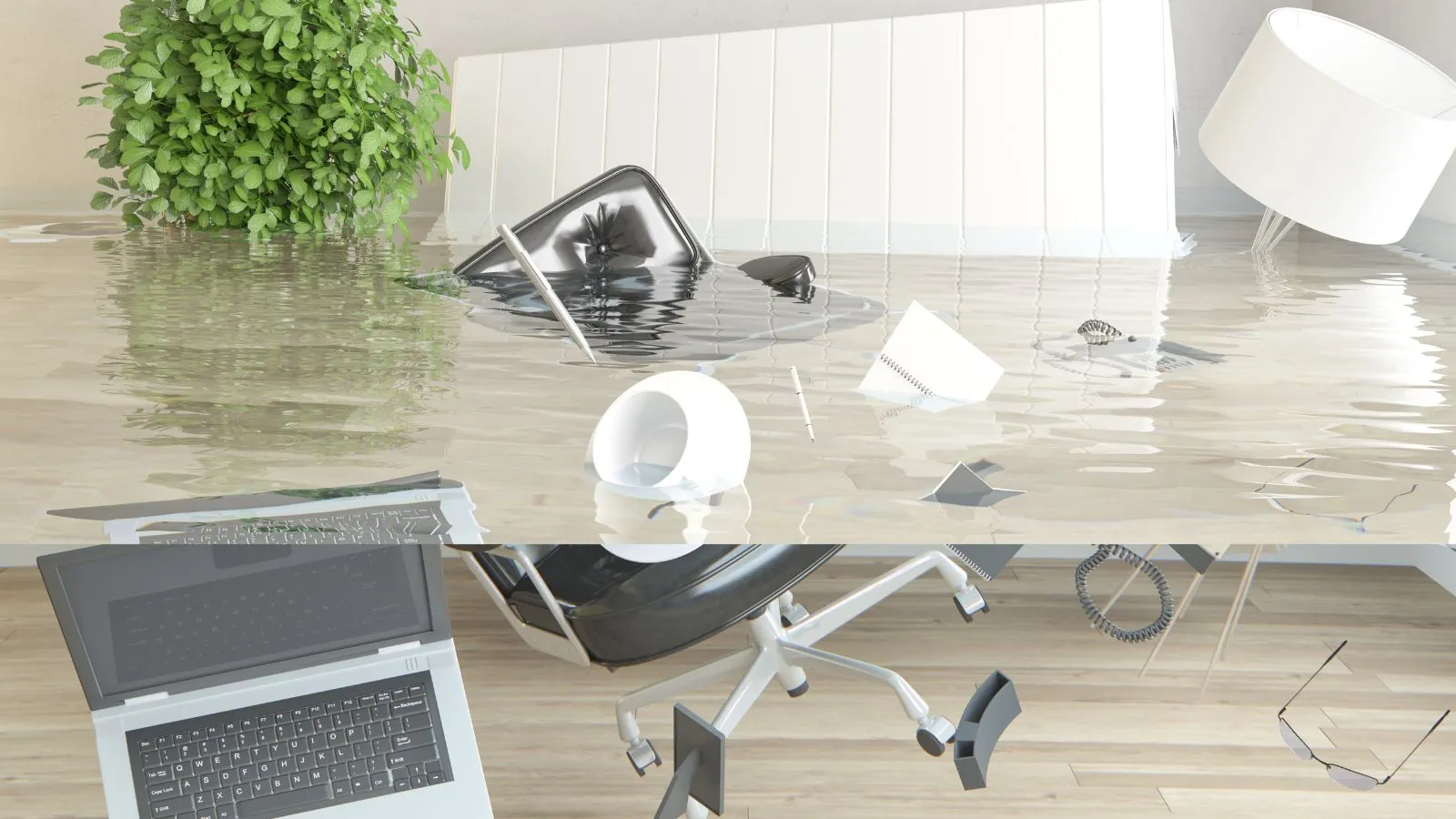
Water in a building that has to stay open
Commercial water damage restoration in Uniondale, NY has a clock that residential jobs lack, which is lost business. Our 24/7 line is open now, and while you wait, shut the water supply to the affected area, keep staff and customers out of wet zones, and lift inventory, files and electronics off the floor.
If water is near panels, ceiling lights or equipment, stay out and call the utility or 911 before calling us. Shut off power to wet areas only if the panel can be reached dry.
- Find and close the nearest shut-off valve, or call the building engineer
- Move records, stock and IT equipment to dry ground
- Photograph before moving anything and note the time you found the loss
- Tell the landlord or tenant of the adjacent space
After-hours calls get the same dispatch process as daytime ones, with same-day response when available, since a Friday night loss can be a Monday morning shutdown.
What makes a commercial loss different
Commercial buildings have larger floor areas, shared walls, ceilings full of mechanical systems and many people with a stake in the result. A single failed pipe can reach several tenants.
The work also has more moving parts: security and access rules, fire alarm panels, tenant schedules and the lease. Crews plan around them, which is why the first call should include who holds the keys and who owns the repair decision.
Local buildings, and what scale does to a water loss
Hempstead Turnpike runs through Uniondale and is lined with offices, retail strips and mixed-use buildings. In a strip building, a leak in one unit can travel along shared walls and ceilings into the next, so the neighbors need to be checked too.
Venues the size of Nassau Veterans Memorial Coliseum are an example of how large assembly buildings work. Big roofs, long drain runs and wide floors mean a leak can spread across a lot of surface before staff find it, and extraction and drying equipment is sized to match.
Campuses such as Hofstra University and Nassau Community College show another type, with dormitories, classrooms and labs. A leak in a residence hall is a multi-unit problem with many occupants. The same goes for corporate offices like the Lufthansa US headquarters, which is a reminder of how cabling, carpet tile and ceilings complicate an office loss. These are examples of building types only, and we do not claim work at any named property.
Where water comes from in commercial buildings
- Burst or leaking supply lines and fire-sprinkler discharge
- Roof leaks, clogged roof drains and flashing failures
- HVAC condensate and cooling equipment
- Sewer or floor drain backups in restrooms and kitchens
- Water heater and boiler failures
- Neighbor-unit leaks coming through a shared ceiling or wall
Some sources are contaminated. If a restroom or kitchen drain backs up, the work follows the rules on the sewage backup cleanup page.
How a commercial job runs
The crew starts with a walk-through, then works in an order that limits downtime.
- Stop the source and secure the area, with building management or the landlord.
- Map moisture with meters and thermal imaging across floors, walls and ceilings.
- Extract water with portable and truck-mounted units, which matters on large floor areas.
- Remove wet carpet tile, ceiling tile, insulation and drywall that cannot be saved.
- Place air movers and LGR or desiccant dehumidifiers and log daily readings.
- Hand over a written scope and records for the owner, tenant and insurer.
The equipment and drying goals match those in structural drying and dehumidification, scaled to the floor plate.
Keeping part of the building open
Phased work lets a store, office suite or floor reopen while others dry. The crew can seal off wet zones with containment barriers, route hoses and cords away from entrances and set equipment in quieter areas.
That plan depends on the water category, ventilation and what the affected zone sits next to. Some losses have to close an area completely. We state which in the scope, so you can decide with accurate information.
Water is spreading right now? The dispatch line is open around the clock.
☎ (516) 845-9582Tenants, landlords and who handles what
Responsibility for the repair often depends on the lease, the source of water and the insurance on each side. Read your lease and ask your attorney or insurer, because we cannot decide it for you.
A tenant should notify the landlord promptly. A landlord should tell other tenants affected. Each party should photograph its own space and keep inventories, since a single water event can produce several claims.
Choosing a response by building type
| Building type | Main concern | Usual approach |
|---|---|---|
| Office suite | Carpet tile, cabling, ceiling tile | Extract, lift tile, dry slab, protect IT |
| Retail strip | Shared walls and inventory | Check neighbors, stage inventory, phased drying |
| Multi-unit residential | Several occupants, units above and below | Open ceilings in each unit, coordinate access |
| Institutional or campus | Many rooms, large floor areas | Zone the building, truck-mounted extraction |
| Restaurant or kitchen | Floor drains, grease, food safety | Extract, sanitize, clear for reopening by the owner |
What commercial restoration costs and why
Scope drives commercial pricing more than anything. These five factors apply. Commercial scopes often cite ANSI/IICRC S500 by name, so a property manager can ask for the drying goals in the contractor's own words.
- Water category (1, 2 or 3) and how long it sat
- Affected area, usually measured in zones, floors or units
- Materials involved, such as carpet tile, ceiling grid, drywall or concrete
- Drying days and equipment count, which scale with floor size
- Rebuild scope, including tenant improvements and finishes
Business hours, after-hours access and phasing can also change the plan. To get a real number for your property, call the 24/7 line and describe what you see.
Documentation for a business-interruption claim
Commercial policies vary, so check your policy and ask your insurer or broker what applies, including any business-interruption coverage. In general terms, document your losses before cleaning anything up, keep photos or video, keep an inventory of damaged items with proof of value and keep a record of conversations with your insurer.
Moisture readings, photographs and a written scope help, and we provide them. We do not bill insurers directly or promise approval. File as soon as possible, and save receipts for emergency steps taken to protect the property.
Limits, related losses and coverage area
We dry and restore. We do not repair the failed pipe, roof or sprinkler system, and a licensed trade contractor does. Fire-code and reopening decisions belong to the building owner and the authorities.
We dispatch to businesses and buildings in the 11553, 11555 and 11556 ZIP codes. Removal of bulk water is explained in water extraction, and large events with rising water are on the flood damage restoration page.
Frequently Asked Questions
Do you handle commercial water damage emergencies at night or on weekends in Uniondale?
Yes. The dispatch line runs 24/7 for businesses as well as homes. We offer same-day response when available, with no arrival time promised. Tell the dispatcher about access, keys, alarms and the building owner so the crew can start without delay.
Can you keep part of our building open during the work?
Often yes. Containment barriers, phased drying and equipment placement can let unaffected areas keep operating. Some losses, especially those involving contaminated water or electrical risk, require closing an area. The scope says which parts can stay open.
Do you work with property managers and multiple tenants?
Yes. A single loss often touches several units, so the crew coordinates access with the manager and each tenant. Each party should document its own space. Lease terms decide responsibility, and an attorney or insurer can advise on that.
What records do I need for a business-interruption claim?
Policies differ, so ask your insurer. In general, keep photos, a dated timeline, moisture readings, inventories of damaged stock and equipment, receipts and a record of conversations. We provide moisture readings and photo documentation you can give your adjuster.
Do Hempstead Turnpike buildings face particular water risks?
The corridor has offices, retail strips and mixed-use buildings, and many share walls, ceilings or roofs. A leak in one unit can reach the next. Check neighboring spaces early, and report the loss to the owner so everyone can document it.
How big a building can you dry?
Equipment is scaled to the loss, from a single suite to multiple floors. Large losses use truck-mounted extraction and many dehumidifiers on zoned plans. After a walk-through, the written scope lays out what the job needs.