
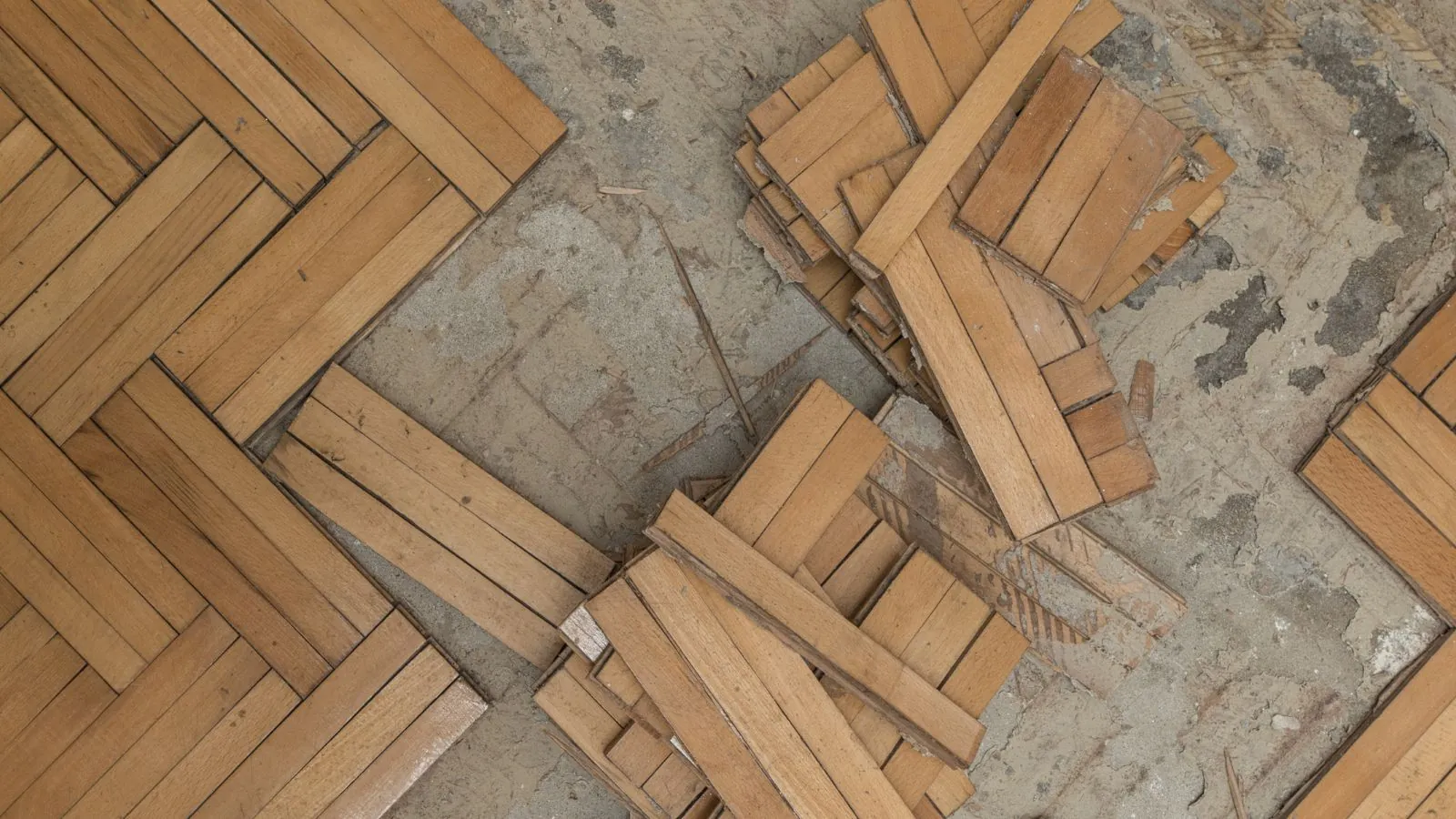
Your boards are warping, and the timing matters
Hardwood floor water damage repair in Uniondale, NY begins the moment you see the edges of the boards rise or the gaps between them open. Wood takes on water through the face, the edges and the underside, and it swells across its width. A floor caught early can often be dried and sanded, while one left wet for weeks can lift off the subfloor entirely.
Cupping, crowning, buckling, gaps and stains
Each pattern points to a different cause and a different fix. Learn which one you have before anyone quotes a replacement.
Cupping
The board edges rise higher than the center, so each plank looks like a shallow tray. It usually means moisture came from below, such as a wet subfloor, a slab or a leak under the floor. Many cupped floors flatten once they are dried slowly and sanded.
Crowning
The center of the board is higher than the edges. It often shows up after a cupped floor was sanded while still wet, or when water pooled on the surface. Crowned boards usually need a wait for stable readings before any sanding.
Buckling
Boards push up off the subfloor in a ridge or peak. This is the severe stage, and it often means the floor has to be released, dried and partly replaced.
Gaps and dark stains
Gaps open when boards shrink after an over-dry. Black or gray stains mean water sat on the wood long enough to react with the finish and the tannins. Stains that reach deep into the grain may not sand out.
Solid, engineered and laminate floors fail in different ways
The type of floor sets your realistic options. Pull up a floor vent or look at a cut edge to see which one you have.
| Floor type | How it reacts to water | Usual outcome |
|---|---|---|
| Solid hardwood | Swells, cups, can dry and flatten | Dry with mats, then sand and refinish if boards are sound |
| Engineered hardwood | Plywood core and veneer can delaminate | Short wetting may dry, repeated or deep wetting means replacing |
| Laminate | Fiberboard core swells at the seams and does not recover | Usually replaced, even after the surface looks dry |
| Hardwood over a slab or basement | Moisture drives up from the concrete | Fix the moisture source first, then dry, then repair |
Laminate floor damage from water is the least forgiving, because the core is made of compressed wood fiber that holds water and swells permanently. Solid wood is the most forgiving, provided it is dried slowly and not forced.
Why wood floors here pick up moisture from below
The ground here is flat, roughly 52 feet above sea level, so pooled water drains slowly. Water from a heavy rain pools on flat ground instead of draining away fast, so it can push against foundation walls and slabs and wick up into floors laid over them. If you saw water in the basement, check the floor above it for cupping within a few days.
Humid summers add another cause. A hardwood floor can cup with no leak at all when damp air and a closed-up house keep moisture high, so the crew checks the humidity before deciding a leak is the culprit.
How we dry hardwood without wrecking it
Hardwood is dried slowly because fast heat can crack the boards and open large gaps. The aim is to bring the wood back to a stable moisture content that matches your home, not to bake it dry.
- Stop the source and have any failed pipe or appliance repaired by the right trade.
- Map the floor with a moisture meter and a thermal imaging camera, then check the subfloor and the slab or the joists below.
- Pull baseboards and, where needed, remove a few boards to open an air path under the floor.
- Set drying mats or panels over the floor to pull moisture out of the boards, with air movers and an LGR dehumidifier running in the room.
- Take daily readings until the wood and the subfloor match a dry reference sample.
- Document the readings and photos so you have a record for your adjuster.
Drying equipment does not repair the floor. Once the wood is stable, a flooring contractor sands and refinishes, and replacement boards are blended in where they are needed.
Want to talk it through with someone? The dispatch line is open around the clock.
☎ (516) 845-9582Replace boards or dry and refinish: the honest trade-offs
Drying mats and panels work best on solid wood that is wet from a clean source and is caught quickly. Floors that have buckled, delaminated or turned black are replaced, because sanding cannot restore a board that has lost its bond to the subfloor.
Sanding and refinishing only happen after the moisture readings are stable, which can take longer than people expect. Sand too early and the boards shrink and open gaps later. If a section is replaced, new boards rarely match old color perfectly, so a full-room refinish is often the cleaner result.
What changes the price of a wet wood floor
Hardwood jobs have a wide spread because they combine drying with a flooring trade. The factors that set the scope are: ANSI/IICRC S500 is the industry reference for drying wood floors, and a crew should be able to say what reading counts as dry for yours.
- Water category: a clean supply leak (Category 1) is far more salvageable than gray or black water
- Affected area: one room, a hallway, or an open floor plan running through the house
- Materials: solid, engineered and laminate floors have very different odds of being saved
- Drying days and equipment: mats and panels over a large floor add setups and monitoring visits
- Rebuild scope: sanding, board replacement and refinishing are a separate trade from drying
To get a real number for your property, call the 24/7 line and describe what you see.
Paperwork if the floor goes on a claim
Take photos and video of the floor before anything is moved, and keep a list of what was damaged. The New York State Department of Financial Services says to document your losses before cleaning up and to expect an adjuster to inspect before permanent repairs.
A standard policy may cover a sudden leak but not flood. Check your policy or ask your insurer. Moisture readings and photos from the drying work can go into your file.
Where we work and what connects to a wet floor
If your property sits in 11553, 11555 or 11556, you are inside the coverage we list. Water that damaged a wood floor often came from a wet room next door, so the crew also looks at carpet and padding in the same area.
If the water rose through the concrete, the cause may be a slab leak that needs a plumber to locate. If a dishwasher or refrigerator line failed, see appliance leak water damage for that side of the loss. The long drying phase itself is described in structural drying and dehumidification, and the coverage map is on the service area page.
Frequently Asked Questions
Can a water damaged hardwood floor be saved?
Often, if it is solid wood, the water was clean and drying began within a few days. The crew uses mats or panels with controlled airflow and checks the readings daily. Boards that buckled, split or turned black are usually replaced.
My floor boards are curling at the edges. Is that a leak or the humidity?
Either one. Cupping from below suggests a wet subfloor, slab or leak, while humidity cupping tends to affect the whole house and ease in drier months. A moisture meter on the boards and the subfloor tells the two apart, which is worth knowing before you refinish.
How long before I can sand and refinish?
Only after the wood and subfloor read stable against a dry reference. That may be days or several weeks, depending on thickness and the cause. Sanding early traps moisture and can cause gaps and crowning later.
Is laminate floor damage from water repairable?
Seldom. Laminate has a fiberboard core that swells at the seams and keeps the swelling even when it feels dry. A short surface spill that is wiped up quickly may be fine, but planks that have lifted are usually replaced.
I have a hardwood floor in a Uniondale apartment. Who deals with the subfloor below?
That depends on who owns the structure. Report the leak to your building manager and landlord right away, because the unit or the slab below may be wet too. Keep photos of the floor and any ceiling stains downstairs, and ask the Town of Hempstead Building Department about permits.