
The phone call is the shortest stage
Most of a water job's timeline is decided after the call, not during it. The length depends on the water category, how many rooms are wet, what the walls and floors are made of, and how quickly the source was stopped. Anyone who quotes a fixed number of days over the phone is guessing.
This guide walks through each stage in order and explains what makes it run long or short. Every job varies, so treat it as a map rather than a schedule.
Stage by stage
A typical job moves through six stages. Some overlap, and some repeat if readings show more moisture than expected.
1. The call and dispatch
You describe what you see, the crew gets the address and the source of water, and you are told what to do while waiting. We offer same-day response when available, but arrival depends on the crew's schedule and conditions, so ask for an estimated window on the call.
2. Assessment and moisture mapping
The crew uses moisture meters and often a thermal imaging camera to find wet areas behind surfaces. They note the water category and damage class and photograph what they find. A large or hidden spread takes longer to map than a puddle on a tile floor.
3. Extraction and removal
Standing water is removed with wet vacuums or extraction units, and unsalvageable materials such as soaked insulation or drywall are cut out. This stage runs long when water is deep, when several rooms are involved, or when contaminated water means more materials must come out.
4. Drying and dehumidification
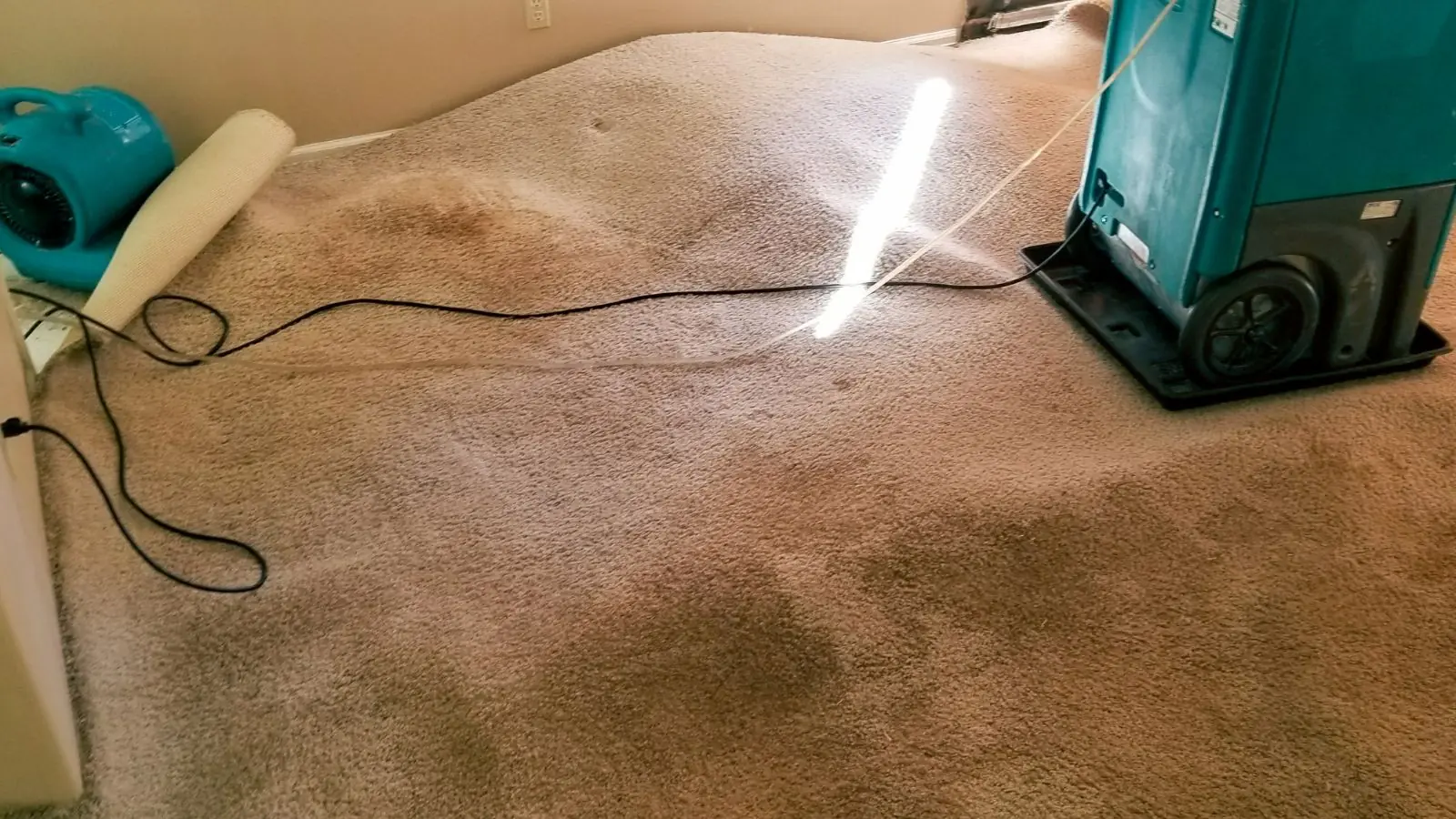
Air movers and LGR or desiccant dehumidifiers are placed, and drying mats may go on floors. This is usually the longest stage, and the approach is covered on the page about structural drying and dehumidification. Dense materials such as framing, subfloor, and plaster release moisture slowly.
5. Monitoring
The crew returns to take readings and adjust equipment. The stage ends when readings reach the dry standard set for that job, not when a set number of visits is done. A reading that stalls tells the crew to move equipment or look for a hidden wet area.
6. Repair and rebuild
Once the structure reads dry, repairs can begin, such as new insulation, drywall, paint, and trim. The page on wall and drywall water damage repair describes that side. Material lead times, trade scheduling, and permit questions can add time here.
What stretches or shortens the job
These variables explain why two jobs of the same size can run very differently.
| Factor | Can shorten the job | Can stretch the job |
|---|---|---|
| Water category | Clean water caught early | Gray or black water that forces more removal |
| Time before action | Source stopped and water extracted fast | Water that sat and soaked into walls and floors |
| Materials | Thin, non-porous surfaces | Plaster, thick framing, subfloor, insulation, hardwood |
| Affected area | One room on one level | Several rooms or multiple floors |
| Humidity and airflow | Mild, dry conditions indoors | Muggy days, closed rooms, blocked airflow |
| Approvals | Adjuster inspection done early | Waiting for inspection before permanent repairs |
Want to talk it through with someone? The dispatch line is open around the clock.
☎ (516) 845-9582What you can do to keep things moving
Owners have more influence on the timeline than they expect. The biggest lever is how quickly the source is stopped and the crew gets access to every wet room.
Clear a path to the affected rooms, move small valuables out of the way, and tell the crew about every wet spot you noticed, including ones that seem minor. A stain you ignored is often where the water traveled. Decide early who can approve work for the household, since a delayed signature delays equipment.
- Stop the source if you can reach the shutoff safely
- Photograph the damage before anything is moved
- Keep doors and closets open so air can reach wet areas
- Do not turn off dehumidifiers to save noise, and do not move them without asking
Records that keep the timeline honest
Ask for the moisture log at each visit. It shows starting readings, current readings, and the target. That log is also what you can show an adjuster, and it keeps everyone from arguing about whether the structure is dry.
The New York State Department of Financial Services says permanent repairs should not be made until the insurer has inspected the loss. If a claim is open, schedule that inspection early so the rebuild stage is not left waiting. Ask your insurer what it wants documented before drying starts, so nothing has to be redone for the file.
Timeline notes for Uniondale, NY
Uniondale's large public and institutional buildings, including the Nassau Veterans Memorial Coliseum, Hofstra University, and Nassau Community College, show why access matters. A commercial loss in a building of that scale involves more rooms, longer corridors, after-hours entry, and downtime concerns than a single home. Those are timeline variables just as much as drying is.
The 2020 Census counted about 8,255 housing units in Uniondale. For many of those homes, the practical timeline questions are simpler: how many rooms are wet, and when can the insurer inspect. We dispatch across the area on the service area page.
Frequently Asked Questions
Why can't you tell me how many days drying will take?
Drying time depends on materials, water category, humidity, and how much water got into hidden spaces. Readings after the first visit give a far better picture than a guess on the phone. Ask the crew to explain the target readings and how they will report progress, and expect those targets to be written down.
Why is equipment still running after the water is gone?
Surfaces dry first, while framing, subfloor, and insulation hold moisture longer. Equipment stays until readings reach the target. Pulling it early risks leaving damp materials sealed behind paint or flooring.
Can repairs start while the walls are still wet?
Usually not. Covering damp materials traps moisture, and the Department of Labor mold guidance says the key to mold control is moisture control. Repairs begin after monitoring shows the structure is dry, and after any insurer inspection that is pending.
Does the cause of the water change how long it takes?
Yes. A clean supply line break caught early is a different job from a drain backup or water that sat for days. Contaminated water means more porous material is removed, which adds steps before drying can even start.
Do humid Uniondale summers slow drying?
Humid weather makes evaporation harder, so dehumidifiers carry more of the load and monitoring matters more. Long Island has humid summers and winter freezes, and both change how a crew sets up. Closed windows and running equipment help control conditions indoors.